
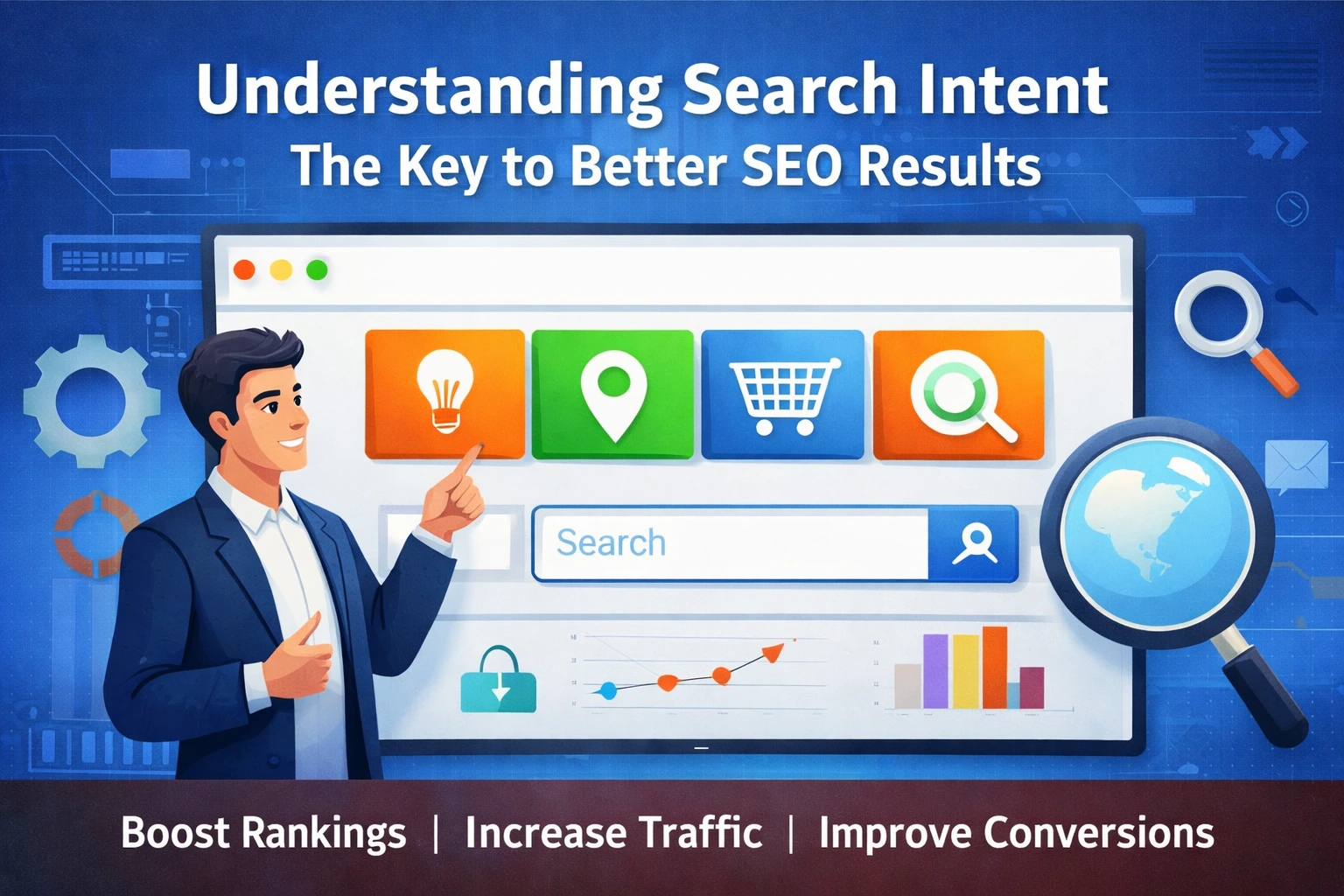
Understanding search intent drives modern SEO success. This guide shows how you can use user intent to improve rankings, grow organic traffic, and increase conversions. Discover the main types of search intent, learn practical strategies to align content with user needs, and apply actionable tips to optimise your pages for Google, ChatGPT, and other AI-powered search systems. Ideal for marketers, content creators, and SEO professionals.
Table of Contents:
- Understanding Search Intent: The Key to Better SEO Results
- Why Does Search Intent Matter for Your Website?
- How Does Search Behavior Affect SEO?
- How Is AI Changing Search Intent?
- What Are the Different Types of Search Intent?
- How Can You Identify Your Audience’s Search Intent?
- How to Create a Search Intent Mapping Table
- How to Optimise Content for Each Type of Search Intent
- Step-by-Step Search Intent Optimisation Checklist
- Common Search Intent Mistakes to Avoid
- Search Intent Examples Across Industries
- How Google Understands and Ranks Search Intent
- Actionable Takeaways for Beginners & Experts
- FAQs: Everything About Search Intent
- Conclusion & Next Steps
What is search intent, and why is it the foundation of modern SEO?
Search intent, also called user intent, is the goal behind a user’s search query. Understanding search intent helps marketers create content that matches what users want. Beginners can start by understanding search intent to build a strong SEO foundation and improve rankings, traffic, and conversions. When content aligns with user intent, search engines rank it higher because it delivers relevant and helpful information.
How understanding user intent can boost rankings, traffic, and conversions:
- Improved SEO performance: Search engines like Google prioritise content that satisfies user intent.
- Higher engagement: Users stay longer and interact more when content matches their needs.
- Better conversion rates: Content designed for intent guides users to take desired actions.
Why Does Search Intent Matter for Your Website?
Understanding search intent is crucial because it determines how Google interprets user queries and decides which content to rank. Websites that align with user intent are more likely to appear higher in search results, attract qualified traffic, and achieve better conversion rates.
Key reasons why search intent impacts your website:
- Google’s content matching: Search engines analyse queries to understand user goals and match them with the most relevant pages for better search results.
- EEAT (Experience, Expertise, Authority, Trust): Google evaluates your content’s credibility and authority to ensure it satisfies user intent. High EEAT signals boost rankings, especially for YMYL (Your Money Your Life) topics.
- User behavior & engagement: Metrics like dwell time, click-through rates, and bounce rates indicate whether your content meets user expectations. Pages that satisfy intent are rewarded with higher visibility.
How Does Search Behavior Affect SEO?
Understanding search behavior helps you create content that matches real user needs. Using an intent-based SEO strategy ensures your pages align with user expectations, improving rankings and engagement.
Key ways search behavior impacts SEO:
- Matching content to queries: Aligning your content with user questions ensures search engines consider your page relevant and rank it higher.
- Semantic search: Google now interprets the meaning behind queries, not just keywords, so content must address user intent contextually.
- NLP (Natural Language Processing): AI-driven algorithms analyze how words, phrases, and entities relate, helping Google understand content relevance beyond exact keyword matches.
How Is AI Changing Search Intent?
Artificial Intelligence is reshaping how search engines interpret and respond to user queries. Tools like ChatGPT, Gemini, and Google SGE influence ranking signals by evaluating not just keywords but context, relevance, and helpfulness of content. Websites that adapt to AI-driven search can stay ahead in rankings and user satisfaction.
Key ways AI is affecting search intent and SEO:
- AI-driven search understanding: Modern algorithms use machine learning to analyze content context, user behavior, and search patterns to deliver precise results.
- Optimising for AI and Google: Focus on creating helpful, high-quality content that aligns with Google’s Helpful Content System, ensuring both human users and AI understand your pages.
- Enhanced relevance and context: AI evaluates entities, semantic relationships, and topic coverage, rewarding content that fully satisfies user intent.
What Are the Different Types of Search Intent?
Identifying search intent before creating content is crucial because it ensures your pages align with what users are actually looking for, improving SEO performance, engagement, and conversions. Understanding intent helps marketers target the right audience with the right content at the right stage of their journey.
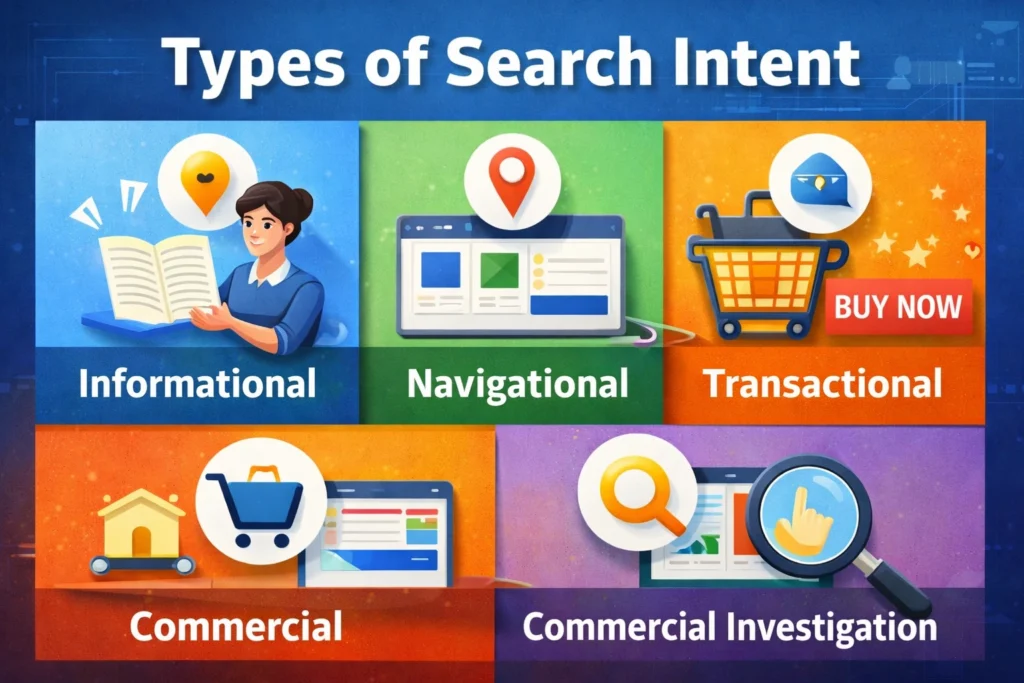
The four main types of search intent:
- Informational Intent
- Navigational Intent
- Transactional Intent
- Commercial Investigation Intent
Informational Intent:
Informational intent occurs when users are looking for answers, explanations, or guidance on a topic. These users are not ready to buy; they want to learn or understand something in detail. Optimising content for this intent helps your website attract qualified traffic and establish authority in your niche.
Examples of informational queries:
- What is SEO?
- Understanding Search Intent
- How to improve website rankings
Best content types for informational intent:
- How-to guides
- Tutorials
- Blog posts
- FAQs and step-by-step articles
Navigational Intent:
Navigational intent occurs when users are searching for a specific website, brand, or page. These users already know what they want and expect to land on the right page quickly. Optimizing for navigational queries improves user experience and ensures your branded content ranks well.
Examples of navigational queries:
- Moz login
- Semrush dashboard
- Flexiv SEO services page
Best content types for navigational intent:
- Landing pages
- Branded content
- Clear, optimised site navigation
Transactional Intent:
Transactional intent occurs when users are ready to take action or make a purchase. These visitors have a clear goal and are looking for content that facilitates conversion, such as product details, pricing, or signup forms. Optimizing for transactional queries helps increase sales, leads, and revenue.
Examples of transactional queries:
- Buy SEO software
- Subscribe to an email marketing tool
- Purchase an online marketing course
Best content types for transactional intent:
- Product pages
- Service pages
- Lead forms
- Pricing pages and CTAs
Commercial Investigation Intent:
Commercial investigation intent occurs when users are researching products or services before making a decision. These users want detailed comparisons, reviews, and insights to choose the best option. Optimising for this intent can guide users toward conversion while building trust and authority.
Examples of commercial investigation queries:
- Best SEO plugins 2026.
- Compare SEO tools.
- Flexiv vs other SEO agencies.
Best content types for commercial investigation intent:
- Comparison blogs.
- Product or service reviews.
- Case studies.
- Buying guides and detailed comparisons.
How Can You Identify Your Audience’s Search Intent?
Understanding your audience’s search intent is crucial for creating content that matches user needs, improves SEO rankings, and drives conversions. By analysing search behavior, you can craft pages that satisfy both users and search engines.
Step-by-step approach to identify search intent:
- Analyse SERP results: Examine the top-ranking pages for your target keywords. Determine what type of content Google favours: informational, transactional, navigational, or commercial investigation.
- Check “People Also Ask” (PAA) sections: Discover related questions users are searching for. Identify subtopics and long-tail queries for content opportunities.
- Look for query modifiers: Words like buy, best, review, how to, and compare reveal user intent type. Help categorise searches and optimise content accordingly.
- Check featured snippets and SERP signals: Analyse QDF (Query Deserves Freshness), snippets, knowledge panels, and rich results. Shows what content Google considers most helpful and relevant.
- Use SEO tools for deeper insights: Tools like Yoast SEO, SEMrush, and Google Search Console can reveal CTR, keyword trends, and engagement metrics. Validates whether your content matches real user behavior and intent.
How to Create a Search Intent Mapping Table.
A Search Intent Mapping Table helps organise your keywords based on user intent, content type, and funnel stage. This ensures every page you create matches search intent, improving SEO, engagement, and conversions. Mapping also helps identify gaps in your content strategy.
Example of a Search Intent Mapping Table:
| Keyword | Intent | Best Content Type | Funnel Stage |
|---|---|---|---|
| What is SEO | Informational | Guide | TOFU |
| Best SEO tools | Commercial | Comparison Blog | MOFU |
| Buy SEO software | Transactional | Landing Page | BOFU |
Tips for creating your table:
- Include primary keywords and LSI keywords for each entry.
- Identify the content type that best satisfies the intent.
- Align keywords with marketing funnel stages: TOFU (Top of Funnel), MOFU (Middle of Funnel), BOFU (Bottom of Funnel).
- Use this table to plan blog posts, landing pages, and product content efficiently.
How to Optimise Content for Each Type of Search Intent.
Optimising content for search intent ensures your pages match what users are looking for, improve SEO rankings, and increase engagement and conversions. Many businesses hire agencies to optimise content for user intent to drive more leads, sales, and conversions.
Best Practices for Intent-Based Content Optimisation:
- Use NLP-friendly phrasing: Ensure both AI tools (ChatGPT, Gemini, SGE) and Google can easily understand context.
- Internal linking: Connect related pages naturally to guide users and boost SEO. Examples:
- SEO Basics for Beginners: Understanding Search Intent
- On-Page & Off-Page SEO: Intent-Based SEO Strategy
- SEO Services: Optimise Content for User Intent
- Include supporting visuals, tables, and examples: Helps satisfy informational or commercial intent effectively.
- Match content format to intent:
- Informational: Guides, tutorials, FAQs
- Navigational: Landing pages, branded content
- Transactional: Product pages, service pages, lead forms
- Commercial: Comparison blogs, case studies, reviews
Step-by-Step Search Intent Optimisation Checklist
Follow this checklist to align your content with search intent: Identify keyword intent: informational, navigational, transactional, or commercial. Map content type accordingly. Optimise headings, meta tags, and snippets. Add examples, tables, and visuals to improve readability and engagement. Monitor dwell time, CTR, bounce rate, and conversions.
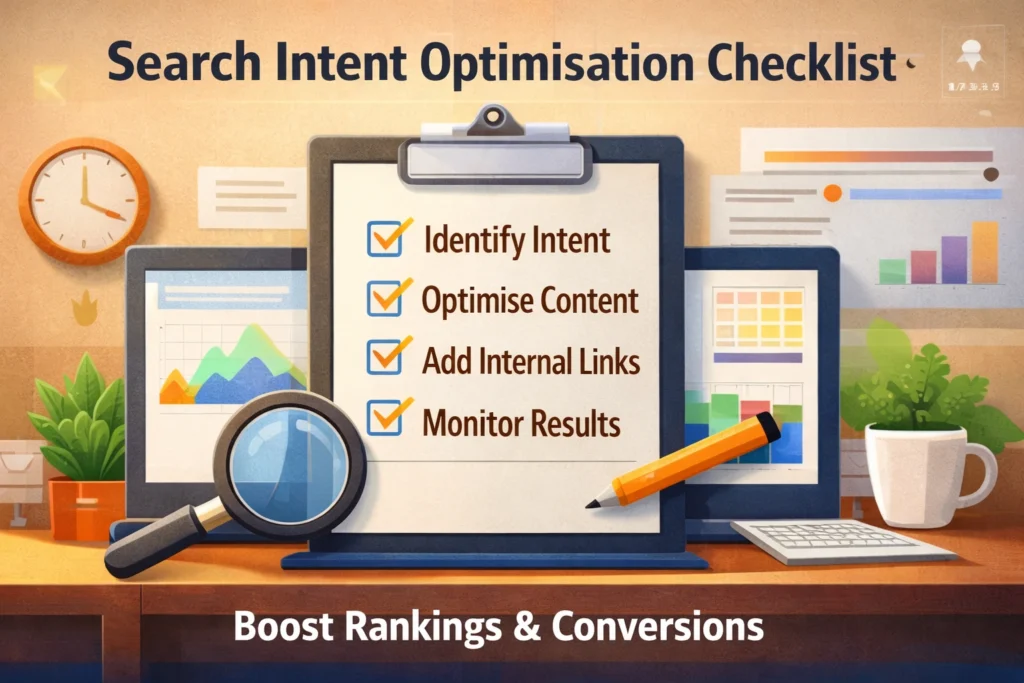
Follow this checklist to ensure your content fully aligns with search intent:
- Identify target keyword intent:
- Determine if it’s informational, navigational, transactional, or commercial investigation.
- Map content type to intent:
- Guides: Informational
- Landing pages: Transactional
- Comparison blogs: Commercial investigation
- Optimise headings, meta tags, and snippets:
- Use keywords and NLP-friendly phrases in H1/H2, meta title, and meta description.
- Add examples, tables, and visuals:
- Enhance readability, engagement, and contextual relevance.
- Monitor engagement and conversions:
- Track dwell time, CTR, bounce rate, and goal completions to refine your strategy.
Common Search Intent Mistakes to Avoid.
Avoiding mistakes in search intent optimisation is crucial for maintaining high rankings, user engagement, and conversions. Many websites fail because they misalign content with intent or ignore SERP signals.
Common mistakes to watch out for:
- Using informational content for transactional keywords: Users looking to purchase won’t convert on a blog post; match content type to intent.
- Ignoring SERP formats & featured snippets: Not optimising for rich results, snippets, and QDF (Query Deserves Freshness) can reduce visibility.
- Over-reliance on SEO tools instead of user behavior: Tools like SEMrush or Ahrefs are helpful, but cannot fully replace analyzing actual search behavior and engagement metrics.
- Not updating content for evolving queries: Search intent changes over time; failing to refresh content for trending queries or QDF topics can drop rankings.
Search Intent Examples Across Industries.
Understanding search intent across industries helps marketers craft targeted content strategies. Different sectors require different approaches to satisfy user queries and maximise SEO results.
Examples by industry:
- SEO & Digital Marketing: Informational: What is SEO? Guide/Blog post.Transactional: Buy SEO software Product/Landing page.
- E-commerce: Commercial investigation: Best running shoes 2026: Comparison blog. Transactional: Buy Nike Air Max online: Product page;
- SaaS: Informational: What is email marketing automation? Tutorial/Guide. Commercial: Compare Mailchimp vs HubSpot Case study/Comparison page.
- Local Services: Navigational: Plumber near me: Landing page. Commercial investigation: Best local SEO agency in Karachi Review/Comparison.
Handling mixed-intent keywords:
- Some queries may combine informational and transactional intent (e.g., “Best SEO tools to buy 2026).
- Use content clusters, guides, and comparison tables to satisfy multiple intents without confusing search engines.
How Google Understands and Ranks Search Intent.
Google evaluates search intent using a combination of SERP features, structured data, and algorithm updates to deliver the most relevant results. By understanding how Google interprets queries, you can optimise content that aligns with both user needs and ranking signals.
Key points on Google’s approach to search intent:
- SERP features: Rich results, featured snippets, People Also Ask, knowledge panels, and local packs help Google gauge intent and relevance.
- Structured data: Proper schema markup allows Google to understand context, entities, and content type, enhancing visibility.
- Helpful Content System & user satisfaction signals: Google evaluates EEAT, dwell time, CTR, and engagement to reward content that satisfies intent.
- Intent changes over time: Search patterns evolve, so regularly update content to reflect new queries, trends, and QDF topics.
Actionable Takeaways for Beginners & Experts.
Whether you are new to SEO or an experienced marketer, applying a structured approach to search intent ensures content delivers value and ranks effectively. Step-by-step framework: Identify: Research target keywords and determine user intent. Validate: Analyse SERP results, People Also Ask, and query modifiers to confirm intent. Map: Use a search intent mapping table to align content types with funnel stages (TOFU, MOFU, BOFU). Optimise: Adjust headings, meta tags, CTAs, visuals, tables, and internal links to satisfy intent. Measure: Monitor engagement, conversions, and rankings to refine strategy continuously.
Step-by-step framework:
- Identify: Research target keywords and determine user intent.
- Validate: Analyse SERP results, People Also Ask, and query modifiers to confirm intent.
- Map: Use a search intent mapping table to align content types with funnel stages (TOFU, MOFU, BOFU).
- Optimise: Adjust headings, meta tags, CTAs, visuals, tables, and internal links to satisfy intent.
- Measure: Monitor engagement, conversions, and rankings to refine strategy continuously.
Tips for maximum impact:
- Include visual frameworks, charts, or tables to clarify mapping and content strategy.
- Use AI insights and SERP signals for ongoing monitoring of evolving search behavior.
- Apply learnings across different industries for informational, transactional, and commercial content.
Conclusion & Next Steps.
Understanding search intent is essential for modern SEO, content strategy, and improving conversions. Websites that align content with user intent rank higher, attract qualified traffic, and generate better results.
Practical steps to implement:
- Use search intent mapping tables to plan keywords and content types.
- Follow checklists for optimising headings, meta tags, snippets, and visuals.
- Include internal links to related pages for deeper learning.
- Regularly monitor SERP signals, engagement metrics, and AI insights to adapt to evolving intent.
FAQs: Everything About Search Intent
Here are the most common questions about search intent with clear answers to help you optimise content and improve SEO results.
What is search intent in SEO?
Search intent, also known as user intent, is the purpose behind a user’s search query. It helps Google and other search engines understand what users want, so they can show the most relevant content, improving rankings, traffic, and conversions.
How do I determine the intent of a keyword?
You can determine keyword intent by analysing SERP results, People Also Ask sections, query modifiers like “buy,” “best,” or “review,” and featured snippets. Tools such as Google Search Console, SEMrush, and Ahrefs also help validate intent using data like clicks, impressions, and engagement metrics.
Can one page target multiple search intents?
Yes, a single page can target multiple search intents, but it must be carefully structured. Using content clusters, comparison tables, step-by-step guides, or structured sections can help address mixed intent without confusing search engines.
How does search intent impact rankings and conversions?
When your content matches user intent, it improves dwell time, click-through rate (CTR), and engagement signals, which are important ranking factors. It also guides users toward conversion actions, increasing leads, sales, or sign-ups.
Why is search intent important for SEO content strategy?
Search intent is important because it helps you create content that matches what users actually want. By aligning your SEO content strategy with intent-based keyword research, you can attract targeted traffic and improve overall search visibility.